All Tags
AWS
ai
algorithm-design
architecture
browser
cloud
cloud-efficiency
cloud-principles
cost-reduction
data-centric
data-compression
data-processing
deployment
design
documentation
edge-computing
email-sharing
energy-efficiency
energy-footprint
enterprise-optimization
green-ai
hardware
libraries
llm
locality
machine-learning
maintainability
management
measured
microservices
migration
mobile
model-optimization
model-training
multi-objective
network-traffic
parameter-tuning
performance
queries
rebuilding
scaling
services
storage-optimization
strategies
tabs
template
testing
workloads
Tactic: Fragmentation
Tactic sort:
Dark Tactic
Type: Unsustainable Pattern
Category: edge-computing
Tags:
Title
Fragmentation
Description
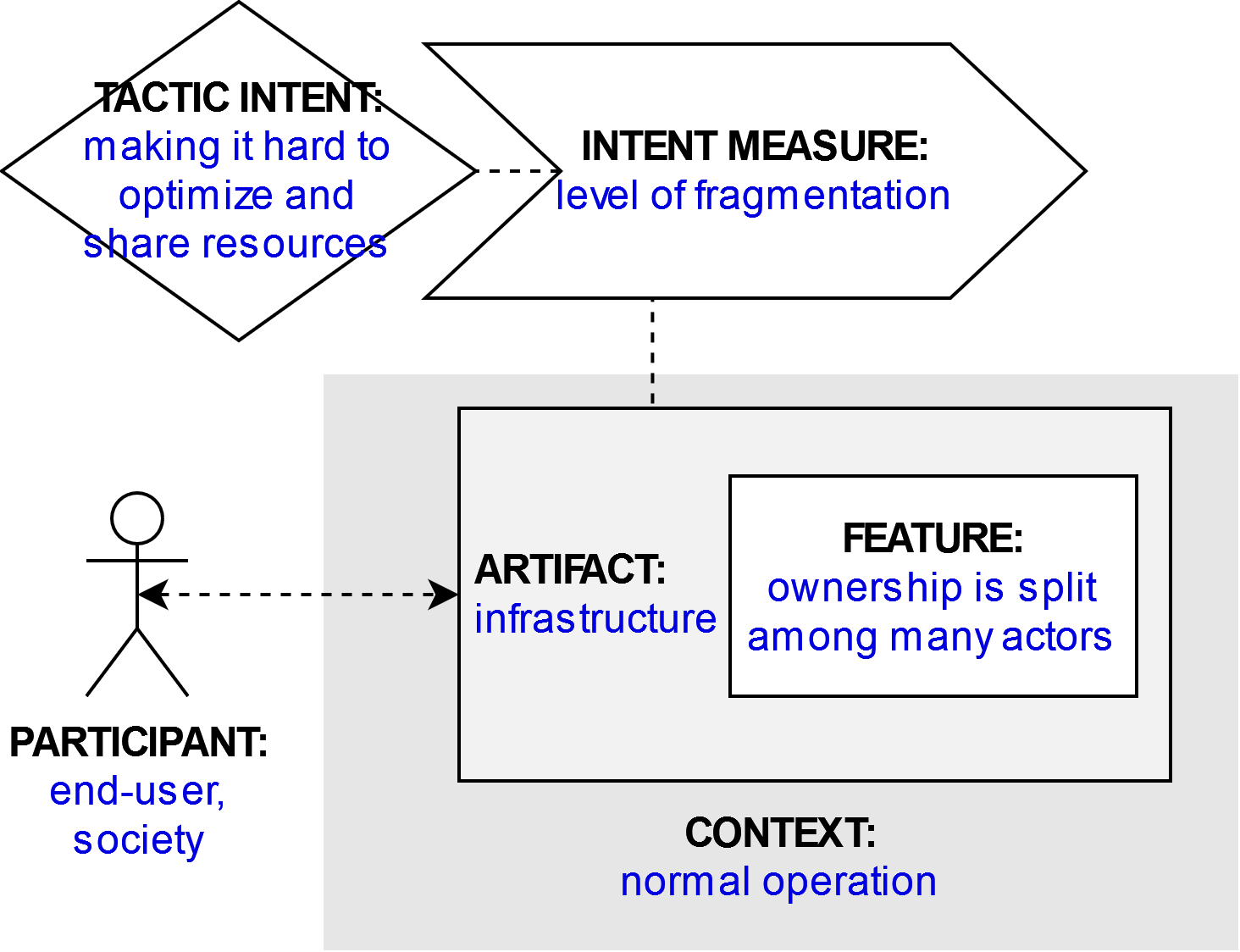
Edge computing infrastructures are distributed across multiple actors and include a variety of devices. Moreover, the edge applications are also very diverse and do not require the same type of service from the edge provider. This creates fragmentation and silo thinking of different natures. Four types of such silos have been identified: application-specific, software-stack-specific, data source-specific, and provider-specific.
Participant
end-user, society
Related artifact
Infrastructure
Context
Normal operation
Feature
Ownership is split among many actors
Tactic intent
Making it hard to optimize and share resources, hindering communication outside of your edge (silo thinking)
Intent measure
Level of fragmentation (how many actors in a given area)
Countermeasure
The concept of Edge Exchange can be introduced as a way to enable cross-actor cooperation and resource sharing, while still providing control and accountability.
Source
*The Dark Side of Cloud and Edge Computing* by Klervie Toczé, Maël Madon, Muriel Garcia and Patricia Lago (DOI: https://doi.org/10.21428/bf6fb269.9422c084)Graphical representation