All Tags
AWS
ai
algorithm-design
architecture
browser
cloud
cloud-efficiency
cloud-principles
cost-reduction
data-centric
data-compression
data-processing
deployment
design
documentation
edge-computing
email-sharing
energy-efficiency
energy-footprint
enterprise-optimization
green-ai
hardware
libraries
llm
locality
machine-learning
maintainability
management
measured
microservices
migration
mobile
model-optimization
model-training
multi-objective
network-traffic
parameter-tuning
performance
queries
rebuilding
scaling
services
storage-optimization
strategies
tabs
template
testing
workloads
Tactic: Consider Reinforcement Learning for Energy Efficiency
Tactic sort:
Awesome Tactic
Type: Architectural Tactic
Category: green-ml-enabled-systems
Title
Consider Reinforcement Learning for Energy Efficiency
Description
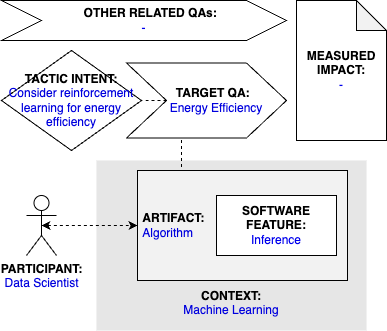
Algorithms can be designed to optimize energy efficiency through reinforcement learning. Reinforcement learning receives feedback on its actions and adjusts its behavior accordingly. Reinforcement learning models can be used to identify the most energy-efficient options in real-time and make informed decisions based on this information. Additionally, other quality attributes can also be targeted for optimization.
Participant
Data Scientist
Related software artifact
Algorithm
Context
Machine Learning
Software feature
Inference
Tactic intent
Improve energy efficiency (or other quality attributes) by using reinforcement learning algorithms
Target quality attribute
Energy Efficiency
Other related quality attributes
< unknown >
Measured impact
< unknown >
Source
Young Geun Kim and Carole-Jean Wu. 2020. Autoscale: Energy Efficiency Optimization for Stochastic Edge Inference Using Reinforcement Learning. In 2020 53rd Annual IEEE/ACM International Symposium on Microarchitecture (MICRO). IEEE, 1082–1096. [DOI](https://doi.org/10.1109/MICRO50266.2020.00090); Thaha Mohammed, Aiiad Albeshri, Iyad Katib, and Rashid Mehmood. 2020. UbiPriSEQ—Deep Reinforcement Learning to Manage Privacy, Security, Energy, and QoS in 5G IoT HetNets. Appl. Sci. 10, 20 (Oct. 2020), 7120. [DOI](https://doi.org/10.3390/app10207120)Graphical representation