All Tags
AWS
ai
algorithm-design
architecture
browser
cloud
cloud-efficiency
cloud-principles
cost-reduction
data-centric
data-compression
data-processing
deployment
design
documentation
edge-computing
email-sharing
energy-efficiency
energy-footprint
enterprise-optimization
green-ai
hardware
libraries
llm
locality
machine-learning
maintainability
management
measured
microservices
migration
mobile
model-optimization
model-training
multi-objective
network-traffic
parameter-tuning
performance
queries
rebuilding
scaling
services
storage-optimization
strategies
tabs
template
testing
workloads
Tactic: Choose an energy efficient drift detection algorithm
Tactic sort:
Awesome Tactic
Type: Software Practice
Category: green-ml-enabled-systems
Title
Choose an energy efficient drift detection algorithm
Description
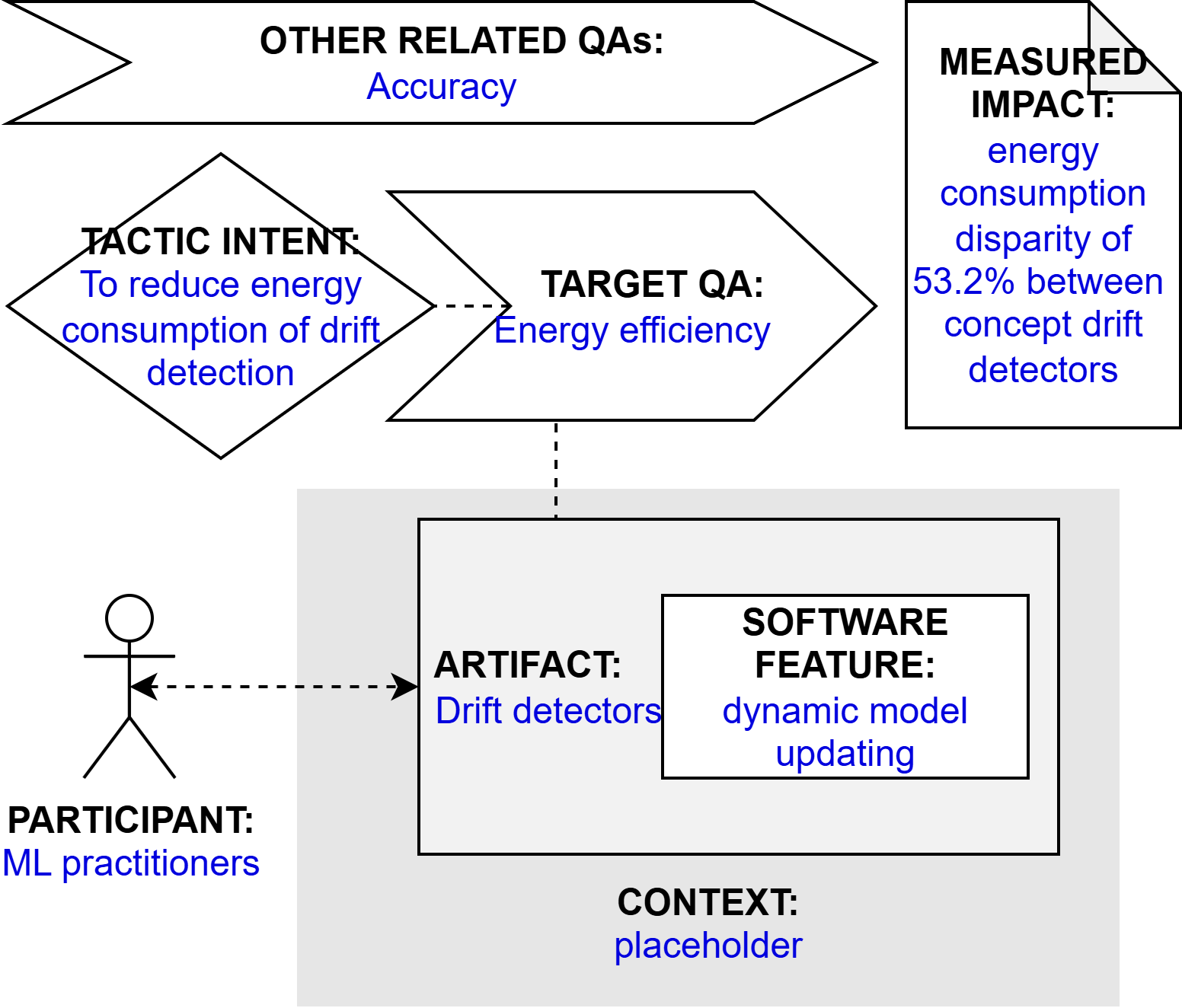
Select concept drift detection algorithms with energy efficiency in mind, ensuring a balanced trade off between detection accuracy and energy consumption. Since drift detectors themselves consume energy and may trigger retraining procedures, false positives from low accuracy detectors can lead to unnecessary retraining, thereby increasing the overall energy footprint. Therefore, when concept drift checks are infrequent or retraining is significantly more energy consuming than detection, it may be preferable to use more accurate detectors even if they are energy intensive (e.g., KSWIN for abrupt drift). Conversely, in high frequency check settings, detectors with moderate energy use and sufficient accuracy, such as HDDM_W or ADWIN, can reduce redundant computation and maintain overall sustainability.
Participant
ML researchers and practitioners
Related software artifact
Concept drift detectors
Context
ML enabled systems
Software feature
Dynamic model updating
Tactic intent
To reduce the overall energy consumption of adaptive machine learning systems by energy-aware choices when selecting concept drift detection algorithms
Target quality attribute
Energy efficiency
Other related quality attributes
Accuracy
Measured impact
The maximum energy consumption disparity observed between detectors reached 53.2%, with ADWIN consuming considerably less energy than KSWIN for similar accuracy levels
Source
Rafiullah Omar; Justus Bogner; Joran Leest; Vincenzo Stoico; Patricia Lago; Henry Muccini (2024) How to Sustainably Monitor ML-Enabled Systems? Accuracy and Energy Efficiency Tradeoffs in Concept Drift Detection (DOI: https://ieeexplore.ieee.org/abstract/document/10805468)Graphical representation